A Card in My Mother’s Bible
As a child, I often watched my mother draw a yellow card, about the size of a postcard, from between the pages of her Bible. She would read it briefly, almost silently, and then put it back with a kind of reverence. It never occurred to me to ask her what it was. Children rarely ask about the things that hold their parents together.
Decades later, after she had passed into glory, I was sorting through her possessions. I opened her old Bible, and there it was: the same yellow card, a little worn at the edges. On it was Psalm 23.
I sat down on her bed and read it through, slowly, several times. I understood it then only in its simplest terms, yet those simple terms were enough. When I came to the last line, “and I will dwell in the house of the LORD for ever”, I felt a deep assurance that my dear mother was now in that house. The thought consoled me more than anything anyone had said to me in those days.
That afternoon my attachment to Psalm 23 began. The card has since moved from her old Bible into the prayer book I read every day. It is the same card, carried by a second pair of hands.
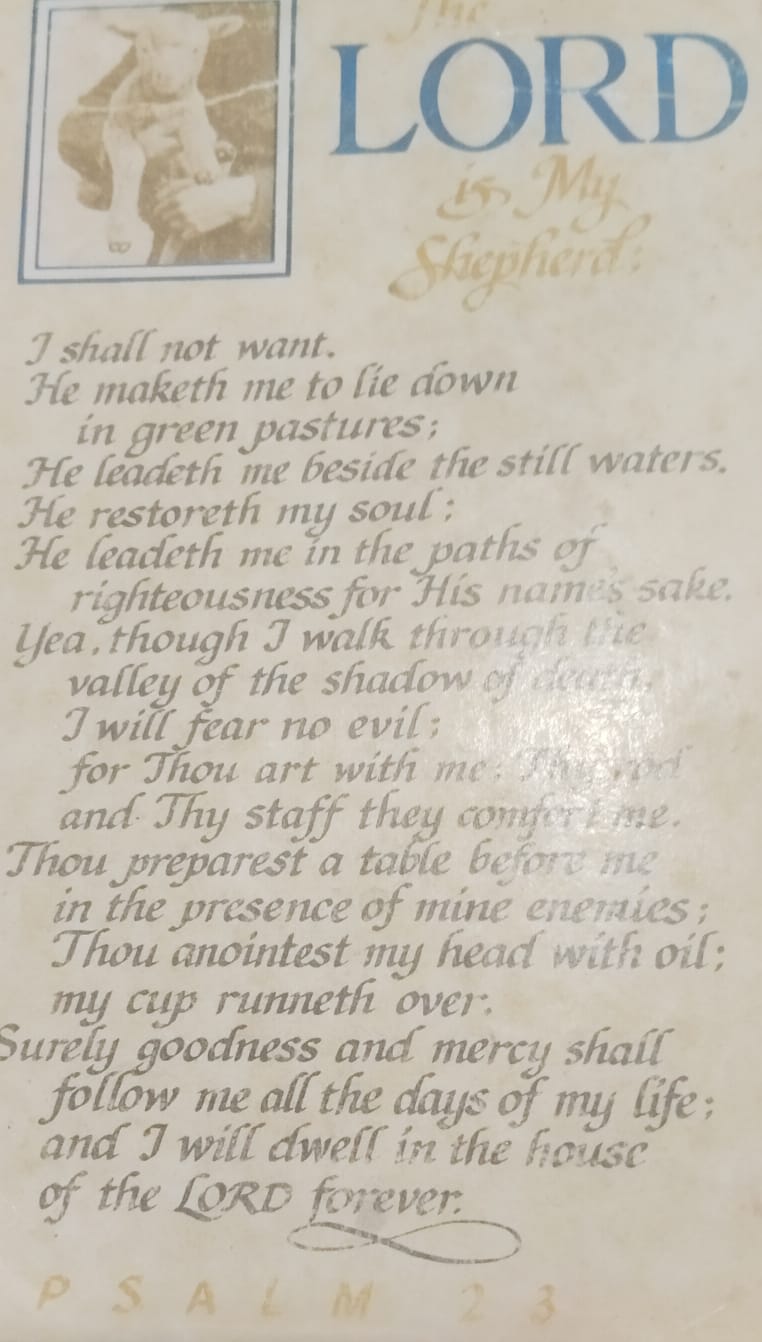
The Faith of a Simple Woman
My mother was a simple person and a devout Christian. She was also, I must admit, a worrier. She carried constant concerns about her children, her household and the days ahead, most of them needless. Yet I watched her return, again and again, to the assurance she found on that yellow card. Her worries were real, but they never had the final word.
Following her example, I too found assurance in the psalm, so much so that I now recite it every day. Only much later did a theological understanding begin to form in my mind. My early attempts to see the verses differently were elementary, shaped mostly by sermons I had heard. All along, though, I sensed that there was more to this short psalm than meets the eye.
There is. What follows is some of what I have found.
A King Who Called Himself a Sheep
We read “The LORD is my shepherd” as a gentle, pastoral line. Its first hearers would have heard something bolder. In the ancient world, “shepherd” was a title for kings. In the prologue to his famous law code, Hammurabi of Babylon calls himself “the shepherd, called by Enlil”, and the shepherd’s crook was among the royal insignia of the pharaohs of Egypt.
The psalm is headed “A Psalm of David”. If so, a king is speaking, and he calls himself a sheep. He confesses that the real shepherding of his life belongs not to the throne but to God. Centuries later, Ezekiel would rebuke Israel’s careless rulers with God’s own words: “I will feed my flock, and I will cause them to lie down” (Ezekiel 34:15).
Three settings, one psalm
We are not told when David wrote these words. Yet the psalm reads beautifully against three moments in the story of God’s people.
David in flight. When his son Absalom rebelled, David fled Jerusalem, crossing the Kidron valley in tears (2 Samuel 15:23). At Mahanaim, beyond the Jordan, with Absalom’s army camped in the same region, three unlikely friends brought beds, bowls, wheat, barley, honey, sheep and cheese, “for they said, The people is hungry, and weary, and thirsty, in the wilderness” (2 Samuel 17:27–29). Scripture does not tie Psalm 23 to that night. But there was a night at Mahanaim when David lived these words: a table prepared in the presence of his enemies.
Israel in the wilderness. The language of the psalm is the language of the Exodus: being led, finding water, needing nothing, a table spread in the desert. It reads like the forty years compressed into six verses.
The return from exile. Isaiah uses the same pictures for God bringing His people home from Babylon: “He shall feed his flock like a shepherd” (Isaiah 40:11), and “by the springs of water shall he guide them” (Isaiah 49:10).
Where the psalm stands, and how it is built
Psalm 23 sits between two great psalms. Psalm 22 begins with the cry of the forsaken, “My God, my God, why hast thou forsaken me?”, and ends with the promise that “the meek shall eat and be satisfied”. Psalm 23 then sets the table. Psalm 24 follows with the King of glory entering His gates.
The psalm itself has a remarkable shape. It opens and closes with the name of the LORD. In the first half, David speaks about God: “He leadeth me … He restoreth my soul.” Then, in the darkest valley, he begins to speak to God: “Thou art with me.” Hebrew scholars have noticed that these words stand at, or very near, the centre of the psalm: by one common count of the Hebrew, twenty-six words come before them and twenty-six after. Whether the poet planned it or not, the truth is plain: the presence of God stands at the centre of the poem, just as it stands at the centre of the valley.
Walking Through the Psalm
“The LORD is my shepherd; I shall not want.” (verse 1)
“I shall not want” is not a promise of prosperity. It is a wilderness confession. Moses used the same Hebrew verb when he reminded Israel of the desert years: “these forty years the LORD thy God hath been with thee; thou hast lacked nothing” (Deuteronomy 2:7). Israel lacked nothing in a place where there was nothing.
There is a quiet music in the original language too. The word for “my shepherd” and the word for “evil” in verse 4 sound almost alike, though they come from different roots. Whether by design or not, the echo is telling: from the opening line, my Shepherd is set against the evil, and the Shepherd prevails.
“He maketh me to lie down in green pastures: he leadeth me beside the still waters.” (verse 2)
When Moses sang beside the Red Sea, he said: “thou hast guided them in thy strength unto thy holy habitation” (Exodus 15:13). The verb for “guided” is the very verb Psalm 23 uses for “leadeth”, and the word for “habitation” springs from the same root as the word Psalm 23 uses for “pastures”. The green pasture is already pointing towards the dwelling place of God, where the psalm will end.
“Still waters” is, literally, “waters of rest”. That word for rest is the one Scripture uses for the rest of the Promised Land: “ye are not as yet come to the rest” (Deuteronomy 12:9). Read in that light, these are not merely quiet streams. They become a foretaste of the inheritance, given on the journey and not only at its end.
“He restoreth my soul: he leadeth me in the paths of righteousness for his name’s sake.” (verse 3)
“He restoreth” uses the great Old Testament word for returning, and for repentance. The word translated “soul” can also mean the throat, or life itself. Coming just after the waters, the phrase carries a lovely physical sense: He revives my parched throat. It can equally mean “He brings me back”, as a shepherd brings back a sheep that has strayed. Refreshment and repentance live in one phrase.
“Paths of righteousness” are, literally, “right tracks”. Some scholars trace the word to the ruts that cart wheels wear into the ground; others to a curving, well-worn trail. Either way, these are tracks that lead somewhere and do not end at a cliff edge. And “for his name’s sake” tells us whose reputation is at stake. A shepherd who loses his sheep shames himself. God guards His flock because He guards His own good name.
“Yea, though I walk through the valley of the shadow of death, I will fear no evil: for thou art with me; thy rod and thy staff they comfort me.” (verse 4)
Many years ago, I woke early on a Sunday morning and began to get ready for church. Suddenly I felt a pain in my chest. It grew stronger and began to spread down my arms. I recognised the symptoms at once and set out for the hospital, only a five-minute walk from my home. I did not want to drive, in case it delayed things.
That walk, with my wife beside me, seemed to last for ever. My feet dragged. I wanted to pray, but what was I to pray? It did not seem right to tell the Lord that I was not yet ready to meet Him. Then Psalm 23 came to my mind, and I knew that whatever might happen, the Lord was beside me. An angioplasty eventually settled the matter. But the lesson of that walk has never left me.
Look closely at the verse, and you will see that it was written for exactly such a walk.
It is a valley you walk through. The word for “valley” means a ravine, a narrow gorge like those that cut through the Judaean wilderness. Shepherds still lead their flocks through such gorges between one pasture and the next. Notice the word “through”. The valley is a passage, not a destination.
It is deep darkness. The Hebrew word traditionally read as “shadow of death” may also be read as “deep darkness”. Both readings are true to life. Every valley of darkness carries something of death’s shadow, and death is simply the deepest of them.
It is where description becomes prayer. Until now, David has spoken about God: “He leadeth me … He restoreth my soul.” Here, in the dark, he turns and speaks to Him: “for thou art with me.” On my walk to the hospital I could not find words of my own. The psalm gave me words, and they were addressed to Someone walking with me. In the light, we talk about God. In the dark, we talk to Him.
It names two kinds of comfort. The word for “rod” also means a sceptre: the shepherd’s club, the instrument of rule and defence against wild animals. The word for “staff” comes from a verb meaning “to lean”. It is something to put your full weight on. Isaiah mocks Egypt as a “staff of this broken reed” that pierces the hand of anyone who leans on it (Isaiah 36:6). God’s comfort is both: a sceptre that defends, and a support that will not snap under the weight of a frightened man walking slowly to a hospital door.
“Thou preparest a table before me in the presence of mine enemies: thou anointest my head with oil; my cup runneth over.” (verse 5)
Many readers feel that the psalm suddenly leaves the sheepfold for a banquet hall. The shift is smaller than it seems. In the wilderness, the doubting Israelites once asked, “Can God furnish a table in the wilderness?” (Psalm 78:19). The Hebrew words are the same as here. Psalm 23 answers their question: yes, He can.
Behind the verse lies the ancient law of desert hospitality. A fugitive who reached the tent of a host came under that host’s protection, and his pursuers could only stand outside and watch. That is what “in the presence of mine enemies” means. The enemies have not vanished. They have simply lost their power over the guest.
“Thou anointest” is, literally, “thou hast made fat”, that is, rich with oil. The word has no linguistic tie to the “green pastures” of verse 2, yet in Hebrew the two sound alike, and the ear catches the echo: the grass of the field has become the oil of the feast. And “my cup runneth over” means a cup filled to saturation, the abundance of those who are “abundantly satisfied with the fatness of thy house” (Psalm 36:8).
The early Church loved this verse. St. Cyril of Jerusalem, in the Mystagogical Catecheses traditionally ascribed to him (4.7), and St. Ambrose of Milan, in On the Mysteries (8.43) and On the Sacraments (5.3.13), taught Psalm 23 (numbered Psalm 22 in their Bibles) to the newly baptised at Easter as a map of what had just happened to them: the still waters of baptism, the oil of anointing, and the table and cup of their first Holy Communion. It remains a fine psalm for any Confirmation class.
“Surely goodness and mercy shall follow me all the days of my life: and I will dwell in the house of the LORD for ever.” (verse 6)
“Follow” is far too gentle a word. The original means to pursue or chase. It is the word used for armies hunting down a fleeing enemy. The enemies of verse 5 have been replaced by new pursuers: goodness, and God’s steadfast covenant love. The believer is hunted down by grace.
Notice how completely we are surrounded. The Shepherd goes before us (verses 2 and 3). He is with us in the valley (verse 4). Goodness and mercy come behind us (verse 6). Before, beside and behind, there is no direction from which God is absent.
The original text holds one last surprise. Where our Bibles read “I will dwell”, the word as traditionally printed in the Hebrew can be heard as “I shall return”, the same verb as “He restoreth my soul” in verse 3. The sentence goes on to say “in the house of the LORD” rather than “to the house”, which is why the ancient Greek translation, and our own Bibles, read “dwell”. Many readers believe the poet meant us to hear both: to return, and to stay. The psalm begins and ends with a homecoming. God brings my life back to me, and at the last, He brings me back home, to dwell there for ever.
Back to the Yellow Card
When I sat on my mother’s bed that afternoon, I took comfort in believing that she now dwelt in the house of the LORD. I know now that the Hebrew allows us to hear something even tenderer: she had returned there. The God who had restored her soul through every anxious day had finally brought her home.
The Christian reading of this psalm holds one more wonder. The Shepherd became a sheep. Isaiah saw Him “brought as a lamb to the slaughter” (Isaiah 53:7). On the night of His arrest, the Son of David crossed the same Kidron valley that David had crossed in tears (John 18:1), and He walked the valley of the shadow of death alone, so that we would never have to. That is why the risen Lamb can be our Shepherd, and lead us “unto living fountains of waters” (Revelation 7:17).
My mother knew nothing of ancient languages or their hidden echoes. She did not need to. She simply knew the Shepherd, and held on to Him through a small yellow card. I hold the same card today, and I hold on to the same Shepherd.
So let me ask you, as I have learned to ask myself: when your own valley comes, and you cannot find the words to pray, whose voice will you hear walking beside you?
Lord Jesus, Good Shepherd, walk before me, beside me and behind me. When I cannot find words, be my words. And when my journey ends, bring me home. Amen.